1. What is Appraise?
Stefan Musch
2025-10-17
Source:vignettes/appraise_introduction.Rmd
appraise_introduction.RmdAppraise
Appraise audits customer risk and opportunity by using proprietary statistical models on transactional data. We work with investors, operators and advisors to: 1. Diligence potential investment opportunities, and 2. Review existing holdings
For an overview of all Appraise material, please head over to the Appraise Google Drive
What is Customer Lifetime Value?
Customer lifetime value (CLV) is one of the key stats to track as part of a customer experience program. CLV is a measurement of how valuable a customer is to your company, not just on a purchase-by-purchase basis but across the whole relationship. CLV is an important figure to know because it helps our clients make decisions about how much money to invest in acquiring new customers and retaining existing ones.
For example, the CLV of a Honda owner might be as much as $100,000 if they are happy with their car or minivan choice and end up buying several through the years. Or the CLV of a regular coffee drinker might be even higher than that, depending on how many cups of coffee they drink a day and where they buy it. Conversely, someone who buys a home twice in their life might only be worth, say, $15,000 to a real estate agent, because while the value of the purchase is huge, the percentage paid to an agent is only a fraction of that.
In the big picture, CLV is a gauge of the profit associated with a particular customer relationship, which should guide how much you are willing to invest to maintain that relationship. That is, if you estimate one customer’s CLV to be $500, you wouldn’t spend more than that to try and keep the relationship. It just wouldn’t be profitable.
How is Appraise different?
The problem right now is that companies tend to have the least amount of information on their most recent and relevant customers, because nobody knows what each of them are going to do in the future. Appraise can make accurate projections for exactly that problem.
Appraise deconstructs customer cohorts to better understand business health and go-forward prospects. Understanding where customer value is concentrated and how customer value is trending helps inform investment decisions. In addition, Appraise leverages probabilistic models that account for customer heterogeneity.
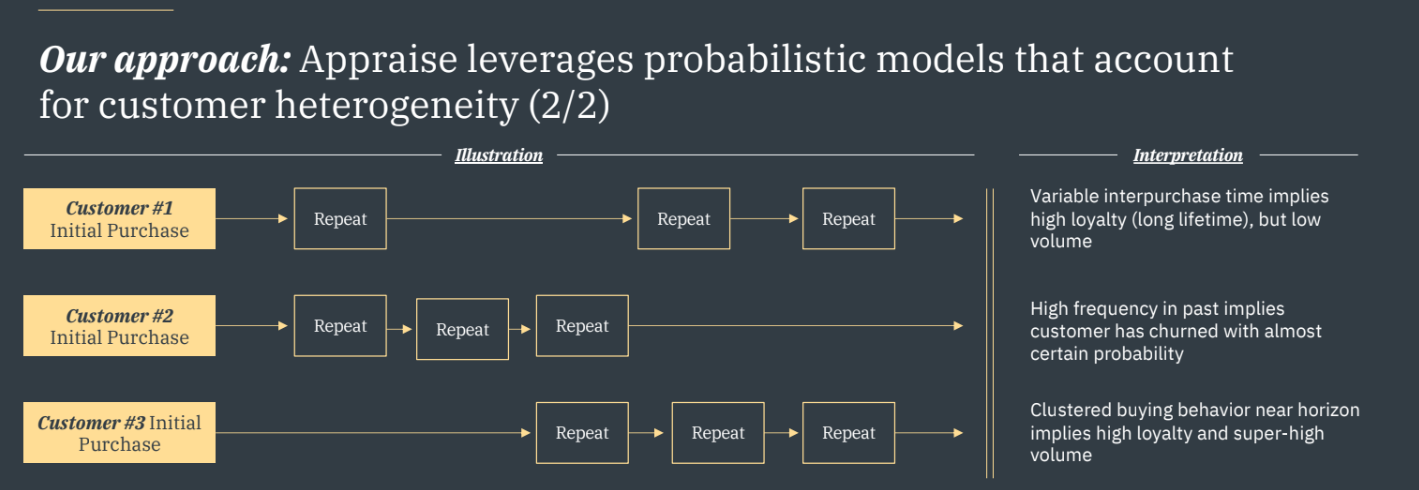
Appraise Approach
Each of these example customers has exactly four purchases: one initial purchase and three repeat purchases.Most models would treat these customers as exactly the same. However, the second customer has almost certainly churned, and the third customer is likely to be the most valuable of all three.
Questions Appraise can answer
- How valuable are my customers?
- What is my expected customer LTV and how much should I be willing to spend to grow share?
- What is contributing to customer value (i.e. retention, purchase frequency, returns, AOV)?
- Are my customers becoming more or less valuable over time?
- Is the payback period (and customer LTV) increasing or decreasing over time?
- To what extent have top-of-funnel marketing increases impacted acquisition costs?
- How much customer value comes from first-orders vs. residual?
- How many purchases are expected and what is predicted spend per order?
- Who are our best and worst customers?
- What features make a specific customer likely to be high- or low-value?
- What products are indicative of high or low LTV?
- Where are your highest and lowest value customers coming from?
- How are paid channels performing vs. organic?
- How is profitability concentrated within the customer file?
- How do demographics impact profitability?