Predict Choice Probabilities for Concepts Across Cohorts
Source:R/predict_for_cohorts.R
predict_for_cohorts.RdGenerates predicted choice probabilities for a set of concepts, aggregated across respondents within specified cohorts. This function allows for different ways of comparing concepts: as a single task, individually against a "none" option, or in separate tasks as specified by a column in the data.
Usage
compare_all_together(allow_none = FALSE)

compare_each_vs_none()

use_task_column(task_col, allow_none = FALSE)

predict_for_cohorts(
  model,
  concepts,
  task_spec = compare_all_together(),
  cohorts = NULL
)
Arguments
- allow_none
Logical indicating whether to include a "none" option in the choice tasks. When TRUE, respondents can choose "none" instead of any concept.
- task_col
Column name or expression identifying which concepts should be grouped together into choice tasks. Concepts with the same task value will be treated as alternatives in the same choice task.
- model
A fitted cjt_model object containing respondent-level part-worth utilities
- concepts
A dataframe where each row describes a concept (alternative) using the same predictors that were used in the model
- task_spec
A task specification object defining how concepts should be compared. Create using
compare_all_together()(default),compare_each_vs_none(), oruse_task_column()(see details).- cohorts
A
cohort,cohort_set, orNULL(for full population). Create cohorts usingg6tr.cohorts::create_cohort()org6tr.cohorts::create_cohort_set().
Value
For a single cohort: The original concepts dataframe with an additional
probabilitycolumnFor a cohort set: A modified cohort set with a new
predictionscolumn containing probability predictions for each cohort
Details
The function computes choice probabilities for each respondent in the specified cohort(s)
and then averages these probabilities using respondent weights. There are three ways to
specify how concepts should be compared using the task_spec parameter:
Task Specification Functions
compare_all_together(allow_none = FALSE): All concepts are treated as alternatives in a single choice task. Setallow_none = TRUEto include a "none" option.compare_each_vs_none(): Each concept is evaluated separately against a "none" option.use_task_column(task_col, allow_none = FALSE): Concepts are grouped into separate tasks based on the specified column. Setallow_none = TRUEto include a "none" option in each task.
Examples
library(dplyr)
library(g6tr.cohorts)
# Create a model
mod <- cjt_model(
nn_choice + allows_none(drn_sub_buy_choice) ~ service + scenario,
data = example_cjt_fp_drn_flat_data,
id_col = id,
task_col = task,
mcmc = list(R = 200, use = 200)
)
#> Logit Data
#> ==================================================
#> Attribute Type Levels
#> -----------------------------------
#> Attribute 1 Linear 1
#> Attribute 2 Linear 1
#> Attribute 3 Linear 1
#> Attribute 4 Linear 1
#> Attribute 5 Linear 1
#> Attribute 6 Linear 1
#> Attribute 7 Linear 1
#> Attribute 8 Linear 1
#> Attribute 9 Linear 1
#> Attribute 10 Linear 1
#> Attribute 11 Linear 1
#> Attribute 12 Linear 1
#> Attribute 13 Linear 1
#> Attribute 14 Linear 1
#>
#> 14 parameters to be estimated.
#>
#> 843 total units.
#> Average of 3.5 alternatives in each of 24 sets per unit.
#> 20232 tasks in total.
#>
#> Table of choice data pooled across units:
#> Choice Count Pct.
#> --------------------
#> 1 5224 25.82%
#> 2 6575 32.5%
#> 3 4399 21.74%
#> 4 4034 19.94%
#>
#> MCMC Inference for Hierarchical Logit
#> ==================================================
#> Total Iterations: 200
#> Draws used in estimation: 200
#> Units: 843
#> Parameters per unit: 14
#> Constraints not in effect.
#> Draws are to be saved.
#> Prior degrees of freedom: 5
#> Prior variance: 2
#>
#> MCMC Iteration Beginning...
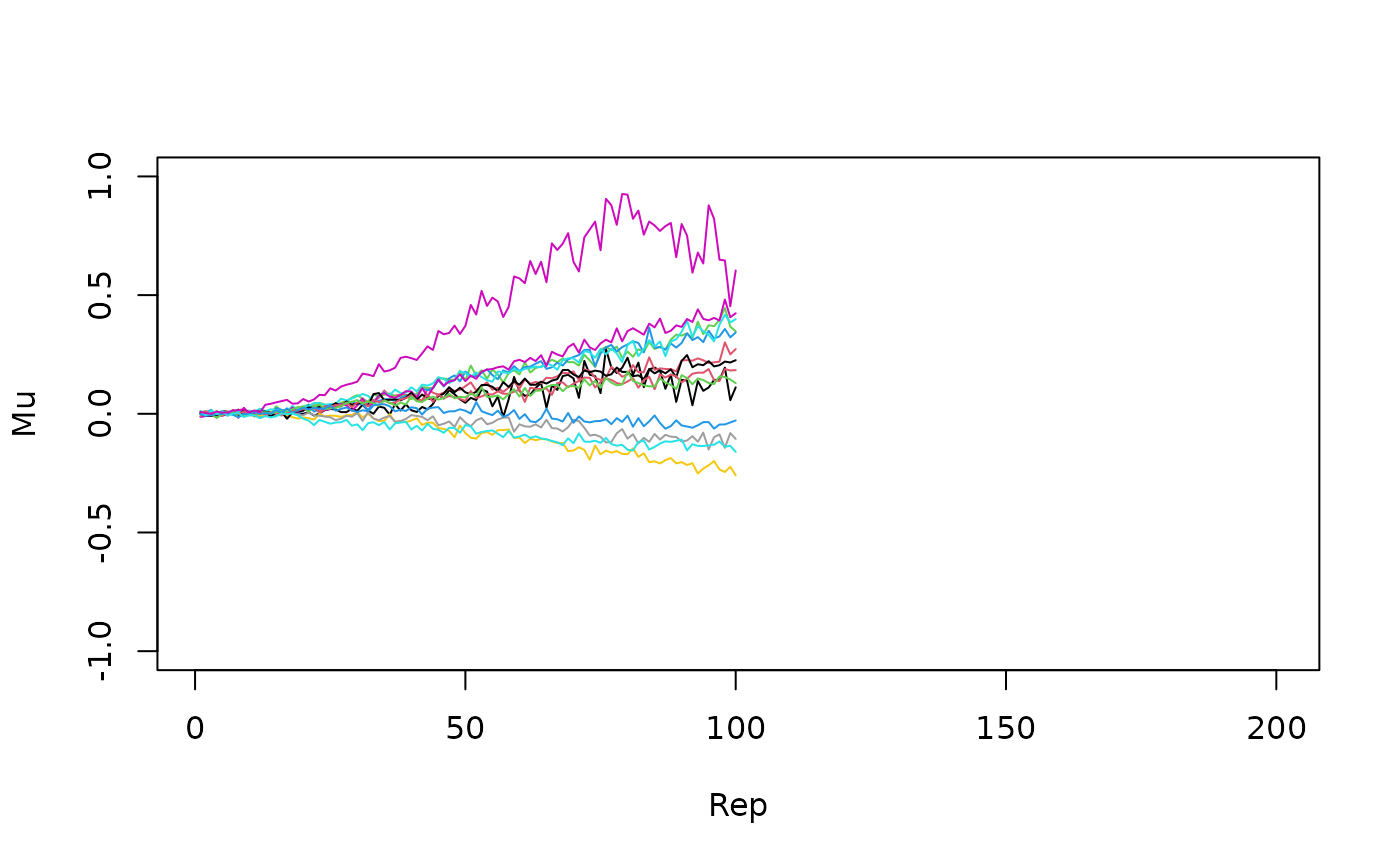 #> Iteration Acceptance RLH Pct. Cert. Avg. Var. RMS Time to End
#> 100 0.362 0.390 0.222 0.41 0.45 0:02
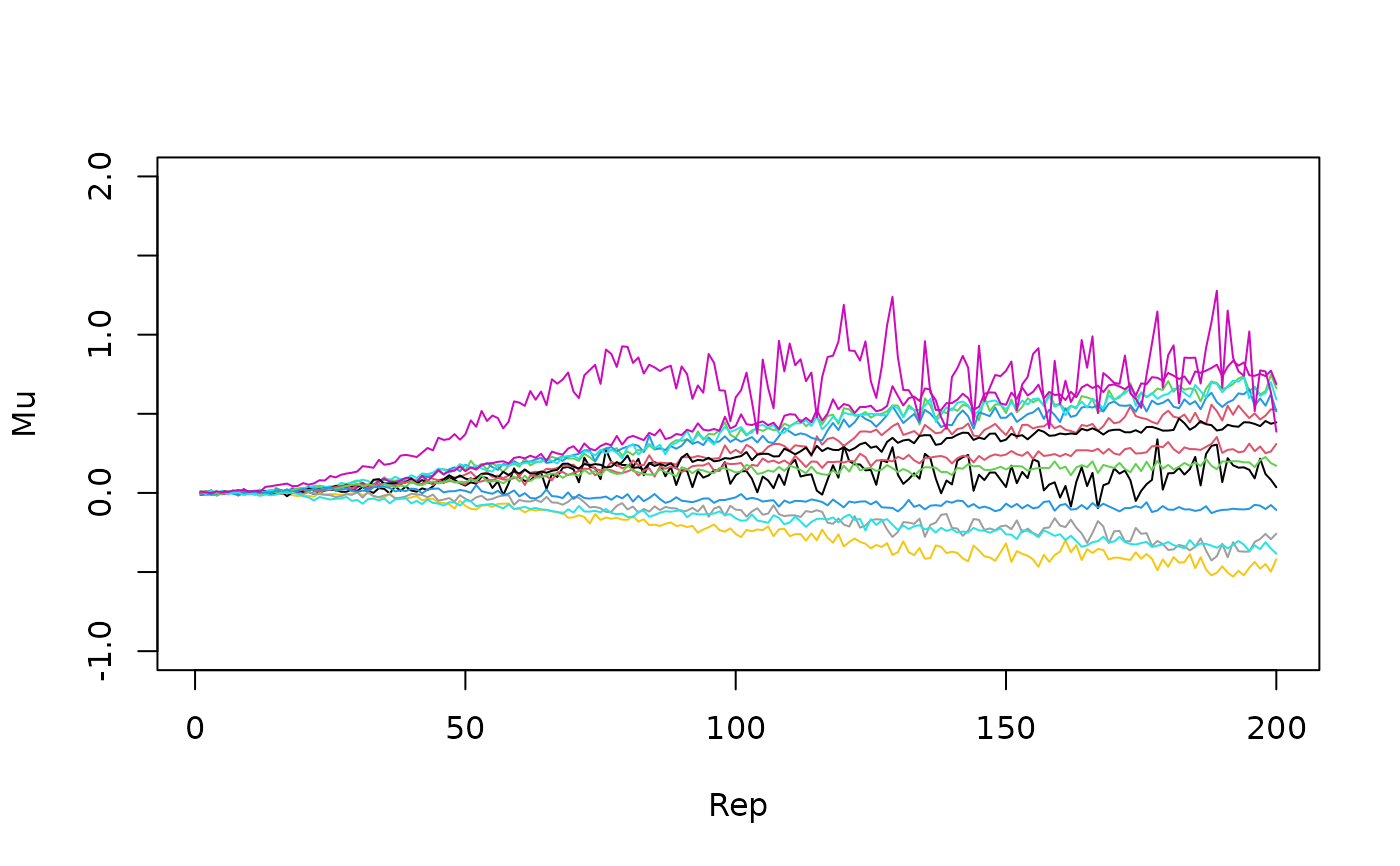 #> 200 0.301 0.507 0.434 1.60 1.16 0:00
#>
#> Total Time Elapsed: 0:04
#>
#> Writing estimated unit-level betas to Rbetas.csv in the working directory
#>
#> Writing RLH, the geometric mean of the likelihood of the choices made,
#>
#> across the choice sets of each unit to RLH.csv in the working directory
#>
# Create some concepts to evaluate
new_concepts <- tibble(
service = c("Apple Music", "Apple One Premier", "Apple One Premier"),
scenario = c("Scenario 1", "Scenario 1", "Scenario 2")
)
# Compare all concepts together (default)
pred_all <- predict_for_cohorts(mod, new_concepts)
#> ℹ No weights provided. Using equal weights of 1.
# Compare all concepts together, including "none" option
pred_all_none <- predict_for_cohorts(
mod,
new_concepts,
task_spec = compare_all_together(allow_none = TRUE)
)
#> ℹ No weights provided. Using equal weights of 1.
# Compare each concept against "none"
pred_vs_none <- predict_for_cohorts(
mod,
new_concepts,
task_spec = compare_each_vs_none()
)
#> ℹ No weights provided. Using equal weights of 1.
# Compare concepts in separate tasks
new_concepts_tasks <- new_concepts |>
mutate(task_id = c(1, 1, 2))
pred_by_task <- predict_for_cohorts(
mod,
new_concepts_tasks,
task_spec = use_task_column(task_id, allow_none = TRUE)
)
#> ℹ No weights provided. Using equal weights of 1.
# Predict for a specific cohort
italy_cohort <- example_cjt_fp_drn_survey |>
filter(country == "Italy") |>
create_cohort(id_col = response_id, weight_col = weight)
pred_italy <- predict_for_cohorts(mod, new_concepts, cohorts = italy_cohort)
# Predict for multiple cohorts
cohort_set <- example_cjt_fp_drn_survey |>
create_cohort_set(
id_col = response_id,
grp_cols = c(country),
weight_col = weight
)
pred_by_country <- predict_for_cohorts(mod, new_concepts, cohorts = cohort_set)
filter(pred_by_country, level == "Spain")$predictions[[1]]
#> # A tibble: 3 × 4
#> task service scenario probability
#> <dbl> <chr> <chr> <dbl>
#> 1 1 Apple Music Scenario 1 0.466
#> 2 1 Apple One Premier Scenario 1 0.272
#> 3 1 Apple One Premier Scenario 2 0.262